
The investment management industry is being disrupted by technological advancements. The old tech stack model followed by most investment firms over the past couple of decades is now showing cracks. This model was characterized by fragmentation, where investment firms used different software products for different processes, such as fund admin, investor relations, etc.
Although this model survived in the past, it does not have what it takes to scale efficiently to handle the market reality of 2026 given the exponential growth in certain market segments. Private markets are at the center of this transformation.
Private markets are growing at a stellar pace. According to PwC, global assets under management will eclipse $200 trillion in 2030. Private markets, bringing in revenues of $432.2 billion, are expected to account for more than half of the investment industry’s revenues by 2030.
The old, fragmented tech stack system is now being replaced by unified platforms that cater to all aspects of the investment management process. Building smarter investment platforms is the key theme for investment firms as we move into 2026 amid the digital transformation of private capital markets. The future is not about having different types of software products with more buttons, but about having a single source of truth.
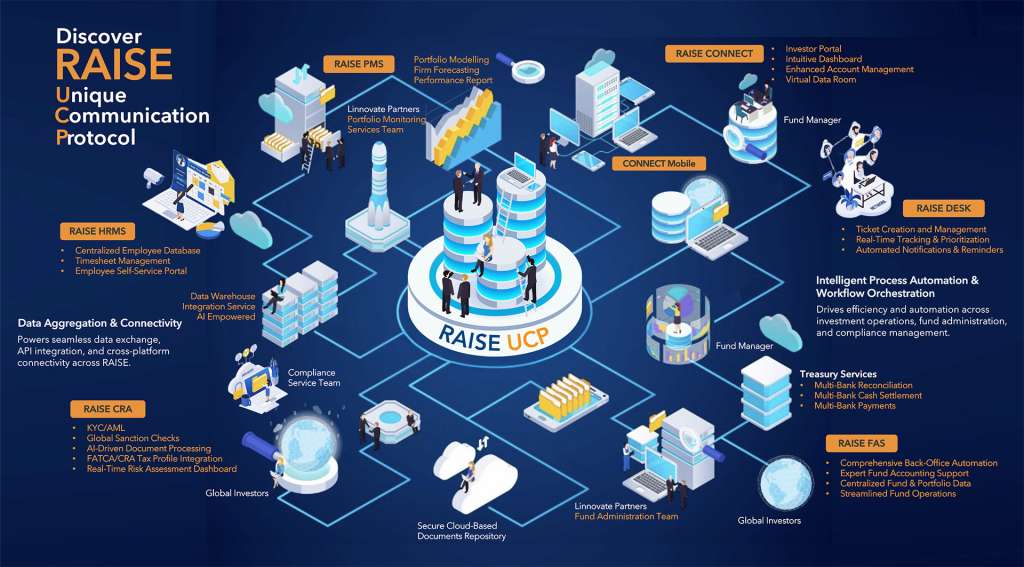
This concept of a unified ‘single source of truth’ is the core engine behind the RAISE ecosystem.
The Industry Shift From Point Solutions to Unified Ecosystems
The industry shift to embrace unified ecosystems stems from the operational challenges that have appeared within the legacy tech stack system. According to Deloitte, U.S. retail investors’ allocation to private capital markets will grow exponentially between 2025 and 2030, boosting AUM from $200 billion to over $2.4 trillion, which translates to a CAGR of 76%.. Amid this sheer growth in scale, a third of global asset owners cite obtaining timely, accurate data as their biggest challenge. This is largely due to siloed systems. Data friction has proven to be increasingly difficult to avoid. Given the many systems involved in operational workflows, obtaining a total portfolio view without manual work, including preparing Excel spreadsheets, has become a distant reality.
This is where RAISE FAS, the fund administration services platform, steps in. This forms the foundation of the RAISE ecosystem. By connecting FAS directly to the front office, investment firms can altogether eliminate the delays between fund accounting data and investment data. This integrated investment management ecosystem creates a strong foundation for real-time risk management and data-driven investment decision-making.
The Changing Expectations of LPs
Historically, private market investments were exclusively available for HNIs and institutional investors. These sophisticated investors often had extensive investment time horizons, which made it easier for GPs, as quarterly performance reporting was satisfactory for these investors. Today, the private market investment landscape is changing dramatically with the influx of capital from mass-market investors given how technological advancements have removed many barriers to market entry. This market democratization has forced the industry to rethink the relationship between GPs and LPs. This has resulted in the growing popularity of GP-LP digital collaboration and the wide usage of secure investor portals that allow LPs to log into a secure portal for real-time portfolio monitoring and even signing documents digitally.
This is where RAISE Connect comes into play. This feature-rich platform allows digital onboarding of new clients through secure document sharing as well as seamless performance reporting through its intuitive dashboard, while giving LPs access to enhanced account management features for updating bank details and managing contacts securely. The digital onboarding process eliminates the manual errors common in wet-signature workflows. RAISE Connect also offers a mobile-first experience, ensuring seamless connection on the go, meeting the growing demand from LPs for more transparency and real-time access to portfolio monitoring.
Integration of Automation Tools and AI
At a time when the global economy is being disrupted by AI technology, the investment management industry has nowhere to hide. Private equity digital transformation, in fact, is expected to gather pace in 2026. According to Deloitte, 85% of global organizations increased AI investment over the past year, and 91% of organizations are planning to invest even more next year. However, it might take as long as four years to fully reap the rewards of these investments. The answer is intelligent AI automation as investment firms can reap the rewards of these investments almost immediately. According to AIMA, intelligent AI automation can reduce investor onboarding times by up to 75%, while improving reporting turnaround by 75% as well.
This is where RAISE FAS, the fund admin platform, and RAISE CRA, the compliance assessment platform, can play a key role for investment firms. In combination, these two platforms offer several automation tools, including back-office automation, centralized data systems, a collaborative document repository through seamless connection to RAISE Connect, and AI-driven document processing. These proven automation products are likely to deliver better ROI compared to experimental AI products both in the short and long term. Given that fund administration automation is a key theme for the investment industry today, investment firms can take a step forward to building a smarter investment platform by integrating RAISE FAS and RAISE CRA into their workflows.
Data As a Competitive Asset in Portfolio Monitoring
Once automation removes operational friction, the next step in a unified ecosystem is leveraging data as a strategic asset to enable data-driven investment decision-making. According to a recent Deloitte study, 85% of AI ROI leaders do not solely rely on efficiency metrics to measure success, but use different types of KPIs to measure success. The key differentiator between AI ROI leaders and laggards is how leaders use data to predict future outcomes while laggards focus on historical performance – for instance, evaluating efficiency improvements in hindsight.
For a GP, relying on backward-looking data about portfolio companies is no longer an option to stay on top. With advanced technologies such as automated data ingestion, it is easy to pull real-time data from portfolio companies automatically, which paves the way for investment decisions backed by high-quality, real-time data. RAISE PMS is built to serve this purpose. This product is designed to turn raw data into actionable insights, shifting the investment decision landscape from a reactive one to a proactive one that enables early identification of emerging trends within portfolio companies. Traditional tools such as Excel fall behind RAISE PMS on several fronts, including automated report generation, dynamic dashboards, and real-time insights into risk exposure.
Cybersecurity as the Foundation of Building Investor Trust
A unified, smart investment platform will not be complete without built-in risk management tools. The increased connectivity resulting from the democratization of capital markets and the use of digital portals gives rise to a larger attack surface for cyber criminals. Security through obscurity is no longer an option for investment firms as mobile apps and external devices regularly connect to secure databases. Recent data shows that financial services firms experience ~300 times more cyberattacks than other sectors. To minimize the threat of such cyberattacks, investment firms need to take several actions across their workflows. For instance, it is more secure to send tax documentation or capital calls through a secure portal than to send them as e-mail attachments. Role-based access control is also key as it enables controlling the accessible data for an LP and an analyst.
The RAISE ecosystem is purpose-built to address many of these security pain points. Given the interconnectedness of different products within the ecosystem, investment firms have one secure perimeter to defend rather than trying to secure dozens of different tools. The RAISE ecosystem provides the necessary infrastructure to achieve this objective, including encryption and RBAC.
Takeaway
2026 is the year of the ecosystem for the investment management industry. The old tech stack platform is dying, giving birth to unified ecosystems. Both from an operational efficiency and user experience perspective, unified ecosystems add value to GPs and LPs. Operational maturity and seamless connectivity between back-office accounting and front-office relationships are no longer optional. Firms that adopt such solutions are likely to scale faster and even raise capital more effectively.
Book a demo of RAISE to get a first-hand experience of how you can build a smarter investment platform in 2026.
Explore Other Blogs
- Using Advanced Analytics to Identify Portfolio Risk Earlier
- Designing Scalable Compliance Across Funds and Jurisdictions
- RAISE Technologies at Tokyo Asset Management Conference and FinCity Tokyo Global Forum
- The Great Platform Shift: How Investment Operations Are Moving to Unified Ecosystems in 2026
- The Connected Fund Office: Redefining Efficiency in 2026