

For multi-billion-dollar alternative fund operations, operational bloat has become an existential threat to fund survival. In an era characterized by relentless margin compression and aggressive fee pressure, legacy manual operations threaten to destroy capital at scale. Managing global investment vehicles through fractured administrative workflows, fragmented data silos, and manual oversight is no longer a viable strategy for growth.
This operational friction has fundamentally redefined the responsibilities of the back office. The modern Chief Operating Officer is no longer merely tasked with overseeing administrative tasks or managing standard compliance checklists. Instead, the COO has emerged as the primary defense against margin erosion and institutional capital flight. To preserve profitability and protect complex private markets infrastructure, COOs must transition from administrative managers into strategic enterprise architects.
The scale of this shift is reflected across the entire financial services landscape. Data from the PwC 29th Global CEO Survey reveals that institutional COOs now spend the absolute majority of their time navigating technology deployment, establishing firm-wide operational frameworks, and aggressively modernizing revenue-critical workflows. Survival in the modern market mandates a departure from legacy execution and transforming fund infrastructure from a defensive cost center into a strategic asset.
The Margin Crush and the Cost of Manual Scaling
To understand why legacy scaling models are fundamentally broken, operational leaders must examine the mathematical reality of manual administration. Throwing human capital at complex compliance and administrative tasks actively destroys profitability. The standard industry cost ratio has essentially become a trap for growing organizations. GPs cannot achieve true fund scalability if every new capital deployment requires a linear increase in manual headcount.
Relying on sheer manpower to solve operational friction leads directly to an unsustainable financial burden. When internal teams are forced to manually reconcile data across disparate reporting systems, the cost of executing business operations quickly surpasses the value generated by securing new capital. This dynamic creates a severe bottleneck that chokes global expansion.
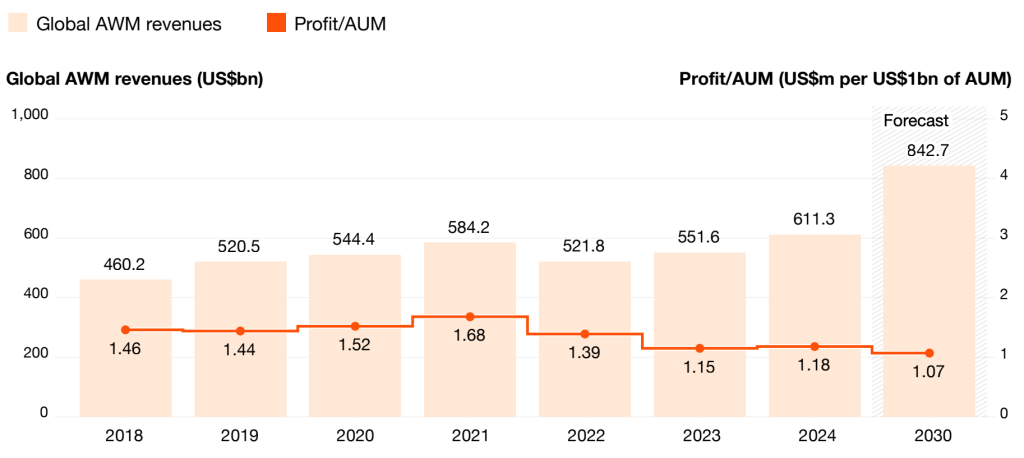
The financial toll of this approach is clearly documented in several market studies. According to the PwC Asset and Wealth Management Revolution Report 2025, 89% of asset managers report experiencing acute profitability pressure over the past five years. As illustrated below, despite strong AUM growth since 2022, profit/AUM has declined due to an outsized rise in costs.
Exhibit 1: PwC Asset and Wealth Management Revolution Report 2025
Source: PwC
Furthermore, according to PwC, the global asset management industry is currently trapped with a bloated average cost-to-income ratio stuck at ~68%. These figures prove that scaling through human effort rather than enterprise architecture is a mathematical impossibility for the modern mega fund.
The Infrastructure Gap Threatening Capital Deployment
Private markets require velocity, but specific technological failures are preventing funds from moving fast. When subjected to scale, legacy operations immediately fracture. Funds attempting to manage global portfolios without an enterprise-grade foundation quickly find themselves limited by their own data silos and manual reconciliation processes.
These internal gaps do more than just slow down daily reporting. They prevent GPs from scaling complex products for private client capital efficiently. A fragmented data architecture also hinders the deployment of AI. In today’s fast-moving world, failure to keep pace with AI in and of itself could turn out to be a major threat. Advanced algorithmic tools cannot function on top of broken or disconnected reporting structures, leaving massive technological advantages completely out of reach for unoptimized funds.
The reality of this technological deficit is widespread across the industry. According to the EY Global Alternative Fund Survey 2025, 64% of alternative fund managers report struggling with severe internal infrastructure gaps that actively hinder their ability to deploy AI tools at scale. Without resolving these fundamental structural failures, executing a rapid growth strategy becomes impossible.
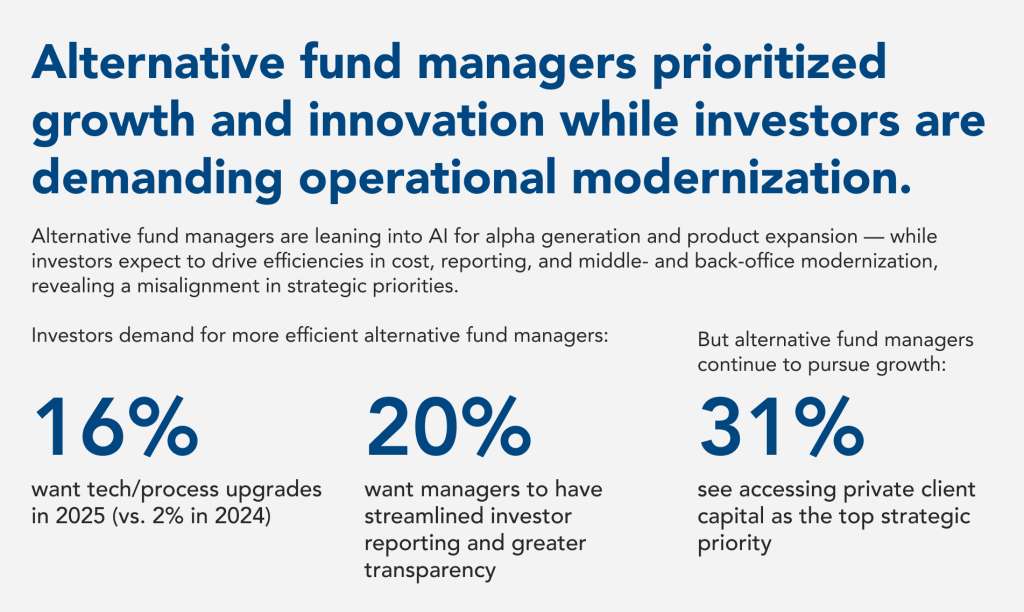
As illustrated below, EY found out that there is a clear mismatch between investor demands and the actions of alternative fund managers. While investor focus is strongly centered on improving the efficiency of the investment process by incorporating innovative tech and through better performance reporting, fund managers continue to focus on growth alone.
Exhibit 2: Priorities of investors and fund managers seem disconnected
Source: EY
GPs who fail to cater to investor demands are likely to find it difficult to raise capital in the long run.
Manufacturing Operational Alpha in a Compressed Market
Although cost saving has been a key topic in the investment management industry for long, the objective of modern fund infrastructure extends far beyond simple cost saving. Rather than treating compliance as a standard back-office function, risk management and operational efficiency must be thought of as active, yield-enhancing tools.
GPs can no longer rely on market tailwinds to generate returns. To combat this reality, the Standards Board for Alternative Investments emphasizes the concept of operational alpha. This framework proves that the modern COO must manufacture yield internally through rigorous operational efficiency and algorithmic monitoring.
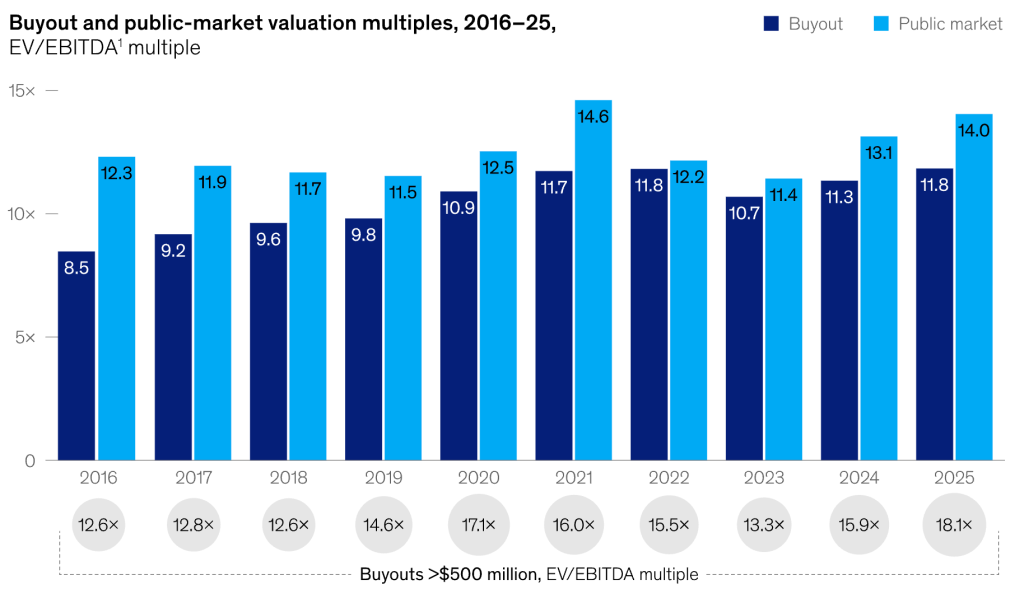
The necessity of this internal yield generation is driven directly by current market mathematics. According to the McKinsey Global Private Markets Report 2026, global buyout deal value surged 20% to reach nearly $1.8 trillion, yet top quartile global buyout returns averaged only 8%. Furthermore, according to McKinsey, median buyout entry multiples increased to 11.8x EBITDA in 2025. Buyouts valued over $500 million were valued at EV/EBITDA multiples of 18.1x on average in 2025, which marked a record high.
Exhibit 3: Buyout valuation multiples reached record highs in 2025
Source: McKinsey
With entry multiples sitting at these elevated levels while returns face severe compression, manufacturing operational alpha through a modernized back office is the only reliable method left to protect the total yield.
The Institutional Veto and Operational Due Diligence
Today’s fund COOs also have to deal with the threat of sovereign wealth audits. Multi-billion-dollar allocators run highly sophisticated risk analytics and demand absolute perfection in governance. During the complex institutional due diligence process, these global allocators look entirely past the investment thesis to interrogate the underlying operational foundation of a firm.
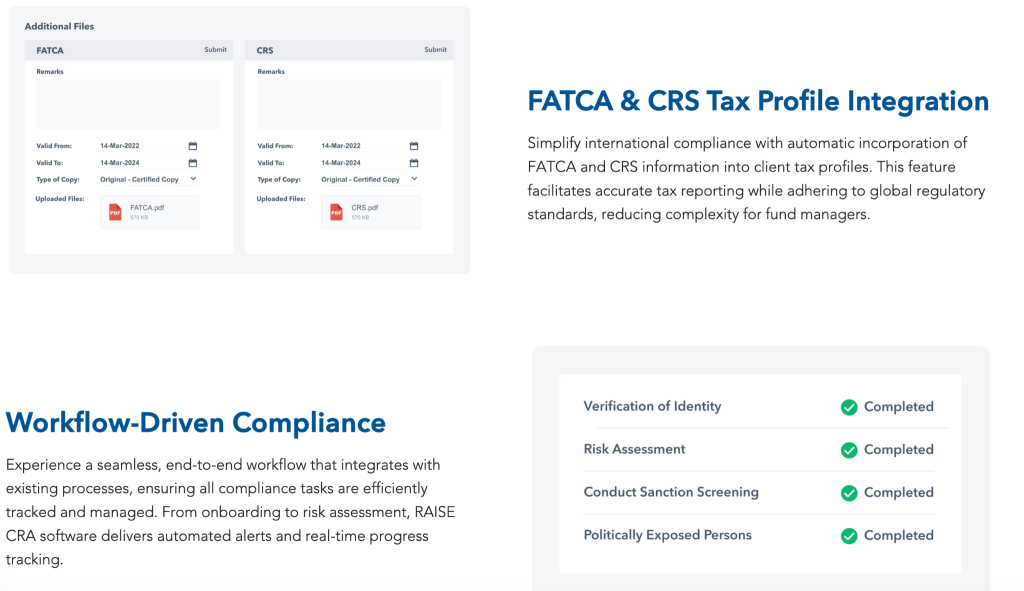
Exhibit 4: Automated compliance workflows on RAISE CRA
Source: RAISE
If allocators discover that a fund relies on legacy spreadsheets disguised as institutional architecture, they will execute a hard veto. Capital will simply not flow into a broken back office. To survive this level of scrutiny, the fund must prove it possesses predictive risk architecture and robust fund compliance automation before any capital is officially committed.
The industry standard for this reporting has shifted dramatically. According to the Standards Board for Alternative Investments 2024 Analysis, institutional allocators are aggressively targeting operational washing and demanding operational alpha. Without a flawless enterprise foundation, funds will fail the audit and lose access to top-tier institutional capital pools.
Conclusion: The Enterprise Architecture Standard
Modern alternative asset managers and COOs who run daily operations can no longer afford to operate with fractured legacy systems. Surviving margin compression and passing rigorous sovereign wealth audits requires a structural solution that eliminates manual friction and installs predictive governance. This is where RAISE Technology comes into play. Rather than functioning as a standard software vendor, RAISE serves as the mandatory algorithmic efficiency engine required to fix bloated cost ratios and pass sovereign wealth due diligence. By deploying this level of operational infrastructure, funds transform their back office from a vulnerable cost center into a strategic moat.
Contact RAISE Technology to implement enterprise-grade operational architecture and secure your next stage of massive scale.