
Private markets are undergoing a massive demographic shift. The democratization of private equity means GPs are no longer just dealing with a handful of sovereign wealth funds. They are now managing hundreds of High-Net-Worth individuals who expect retail-grade user interfaces backed by institutional-grade data.
According to the World Economic Forum, private capital has tripled in recent years and now accounts for roughly 10% of all global capital under management. Amid this growing HNW capital allocation, alternative forms of capital are also gaining traction. For instance, according to McKinsey’s Global Private Markets Report 2026, fundraising into United States semiliquid private equity vehicles has more than doubled since 2023, securing $204 billion in 2025 alone. This strong influx of retail capital and the rise of alternative investment strategies have made legacy reporting methods completely unscalable. LP expectations are changing in a fundamental, structural way. Among the key themes is the demand for real-time LP data access. Investment firms that fail to digitize the private equity investor journey and adapt to this new, data-rich environment are likely to lose their competitive edge in the long run.
Frictionless Onboarding and the Capital Commitment Phase
The private equity investor journey begins long before the first capital call is issued. Poor onboarding processes destroy GP credibility instantly. Legacy KYC and AML workflows still rely heavily on manual document collection.
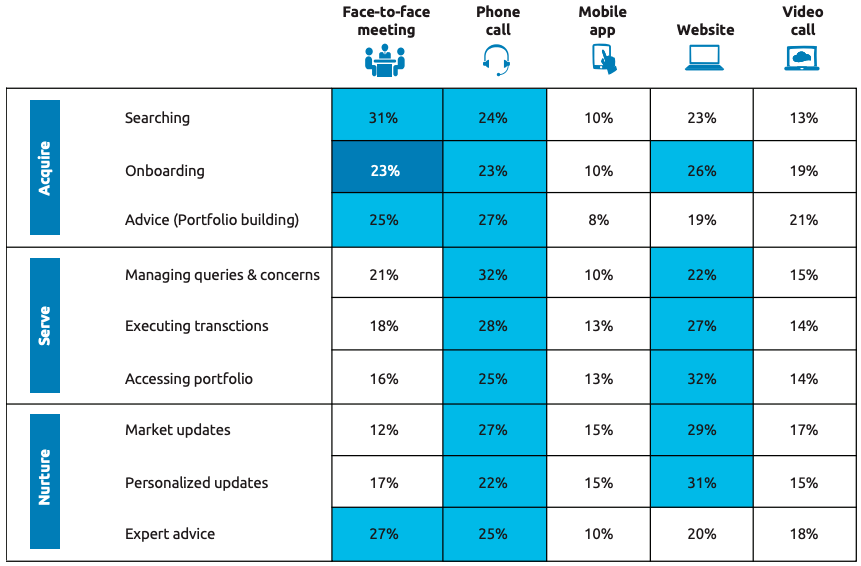
The financial and temporal costs of this friction are severe. According to the 2024 LexisNexis True Cost of Financial Crime Compliance Report, the cost of financial crime compliance has surged past $60 billion annually in North America alone, heavily driven by the labor-intensive nature of manual KYC onboarding. When GPs rely on these fragmented, paper-based workflows, the process can drag on for weeks. This operational drag destroys the investor experience. In fact, Deloitte research indicates that traditional, manual onboarding processes experience abandonment rates as high as 40% to 70% due to sheer friction. Capgemini found that North American HNWIs expect a hybrid approach that combines human and digital service points, whereas digital channels were preferred for many aspects, such as onboarding, portfolio accessing, and receiving market updates.
Exhibit 1: Communication channel preference among HNWIs in North America
Source: Capgemini
To overcome friction, investment firms must implement digital onboarding for private funds. Digitizing subscription documents and automating KYC verification through platforms such as RAISE Connect entirely eliminates this friction. As documented in a recent Deloitte wealth management modernization case, firms that adopt native cloud architecture can achieve a 90% reduction in onboarding time, shrinking a weeks-long process into just hours. GPs must offer this seamless entry point to secure commitments faster and protect their capital supply chain.
The Continuous Reporting Paradigm
Amid the ongoing transformation of the investor journey, the transition to a continuous reporting paradigm is no longer a futuristic concept but a fundamental prerequisite for LP retention. According to an EY global private equity survey, 68% of Limited Partners now rank real-time data access and transparency as a top-three determining factor when evaluating General Partner re-up commitments.
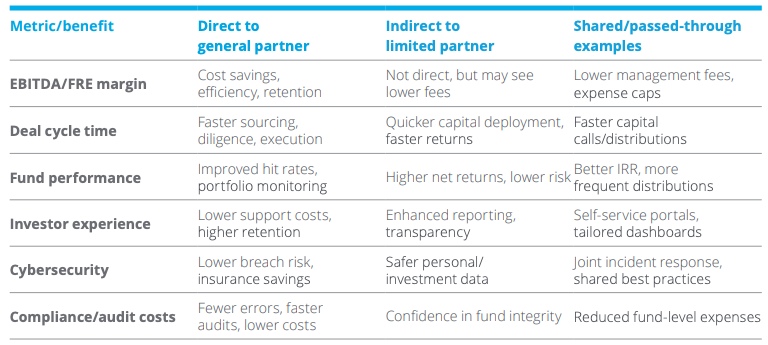
This sentiment is heavily reinforced by recent Deloitte research regarding technology strategies in private markets. Analysts note that a lack of real-time data deters modern investors and actively erodes trust. To counter this, Deloitte explicitly labels the adoption of unified technology infrastructures and next-generation investor portals as a strategic necessity rather than a technical upgrade. Delivering true LP transparency has transitioned from a competitive advantage to an absolute requirement for securing future capital. GPs can no longer turn a blind eye to this changing landscape. Increasing use of AI and advanced digital capabilities are expected to benefit both GPs and LPs, as highlighted by Deloitte.
Exhibit 2: Benefits of technology investments
Source: Deloitte
This is exactly where the native unification of the RAISE ecosystem proves its value. Many legacy software providers attempt to achieve this transparency by patching different back-office and front-office systems together with fragile API integrations. This inevitably leads to data latency and reconciliation errors.
RAISE takes a fundamentally different approach. Because the back-office tools within RAISE FAS and the front-office investor portal within RAISE Connect operate on the exact same platform, data flows instantly. When a valuation updates in the accounting ledger, the LP can view it in their portal immediately. This unified architecture completely eliminates data friction and allows GPs to provide an institutional-grade, real-time data experience.
Dynamic Capital Calls and Liquidity Forecasting
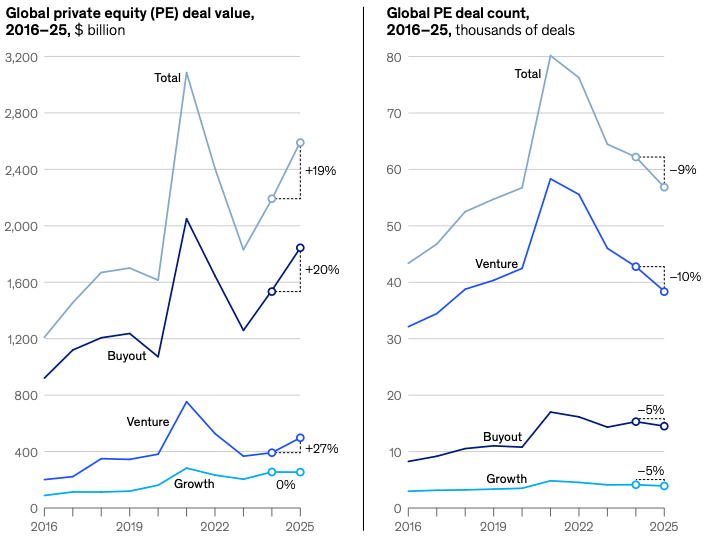
While designing digital journeys for investors, GPs cannot forget how sensitive LPs are to liquidity constraints in the current macroeconomic environment. The ongoing distribution drought has fundamentally altered how institutional allocators manage their cash flow. According to the McKinsey 2026 Private Markets Report, over 16,000 buyout-backed companies globally have now been held for more than four years. This backlog represents an unprecedented 52% of total global buyout inventory. As illustrated below, the number of deals has declined in the past few years, while the growth in total deal value was driven largely by the growing size of individual deals.
Exhibit 3: Global PE deal value and deal count
Source: McKinsey
Because distributions are trapped in aging portfolios, allocators are actively taking liquidity management into their own hands. Evercore reports that global secondaries deal value reached a record high of $226 billion in 2025. LPs are constantly evaluating alternative liquidity mechanisms to navigate this drought. They require precise cash flow forecasting to model their positions accurately before entering these complex secondary transactions.
When GPs issue capital calls using static or delayed spreadsheets in this environment, LPs are caught completely off guard. A digitally designed investor journey solves this tension by providing interactive dashboards. By delivering real-time visibility into unfunded commitments and projected distribution pacing, LPs can manage their liquidity buffers accurately and avoid defaulting on capital calls. Providing this proactive visibility is now mandatory to protect the overall capital supply chain.
Conclusion
A superior investor journey directly impacts the success of the next fundraising cycle. The current capital raising environment is highly competitive. According to Bain & Company, global fundraising timelines are extending by an average of three months. To navigate this friction, GPs must utilize superior digital investor experiences to differentiate themselves and close commitments faster. Firms that treat investor reporting as an administrative afterthought will struggle to secure subsequent funds. Providing a frictionless and real-time data experience is no longer a luxury. It is a critical operational mandate.To transform your investor journey from a static reporting obligation into a dynamic capital raising asset, book a demo to explore the natively unified RAISE ecosystem today.