

For years, the investor portal was treated as a delivery mechanism, a secure mailbox where GPs dropped quarterly PDFs and capital call notices. That framing no longer holds. The 2026 survey data on LP sentiment tells a consistent story: reporting has moved from a back-office compliance task to a front-line factor in capital allocation decisions. LPs aren’t just asking “did I get the report” anymore. They’re asking whether the platform behind it gives them standardized data, real transparency into fees, and the ability to actually use what they’re sent.
Here’s what the numbers say LPs want – and what that means for how a portal should be built.
1. Reporting quality is now a re-up factor, not a courtesy
The days of reporting as an afterthought are over. Ropes & Gray’s 2026 Global Private Equity Report points to extended hold periods and delayed distributions putting real pressure on the LP/GP relationship – and LPs are responding by demanding enhanced reporting, clearer alignment mechanisms, and more rigorous performance benchmarks before committing further capital. Reporting has shifted from a satisfaction metric to a gating factor in how LPs decide whether to re-up.
A portal that can’t produce clean, consistent, on-time reporting isn’t just an operational inconvenience – it’s a fundraising liability.
2. Standardization and comparability are the new baseline
Reporting standards across the industry are converging. New templates from bodies like ILPA – alongside broader shifts toward machine-readable data delivery – are pushing GPs toward more standardized capital account activity, granular fee and expense classification, and consistent performance calculation methodology.
What counts as adequate reporting has moved with it. A 2026 analysis of institutional due diligence found that capabilities once considered “nice to have” are now table stakes for serious institutional consideration – structured data delivery in machine-readable formats, portfolio-company-level financial data, and real-time capital account access through an LP portal, rather than figures delivered weeks after quarter-end. LPs increasingly expect a portal that speaks a standardized language – capital account statements, fee schedules, and performance data that are comparable across every fund in their book, not just internally consistent within one GP’s format.
3. Analytics and self-service, not just document delivery
When LPs are asked directly what would most improve their relationship with GPs, the answer isn’t “send reports faster” – it’s better tools. In one 2026 industry survey of investors, better-quality digital communication interfaces and enhanced reporting analytics ranked among the top requested improvements to the GP relationship, ahead of many other asks.
That’s a meaningful signal: LPs want to interrogate their data – filter by fund, compare vintages, track cash flows over time – rather than opening a static PDF and re-keying numbers into their own systems. A modern portal is judged as much on its analytics layer as on whether the document arrived on schedule.
4. Fee and expense transparency, at a granular level
The operational pain point GPs are feeling most acutely in 2026 is fee transparency. Industry reporting standards now call for far more granular disclosure than before – internal chargebacks broken out from external partnership expenses, subscription line interest itemized, fee offsets tracked by investor commitment tier. LPs aren’t asking for a summary fee line anymore; they’re asking to see how it was built.
Portals that can only produce a static, manually-assembled fee page will struggle to keep pace. LPs are increasingly comparing this level of detail across managers, and inconsistency reads as a red flag.
5. Trust in how AI is used behind the scenes
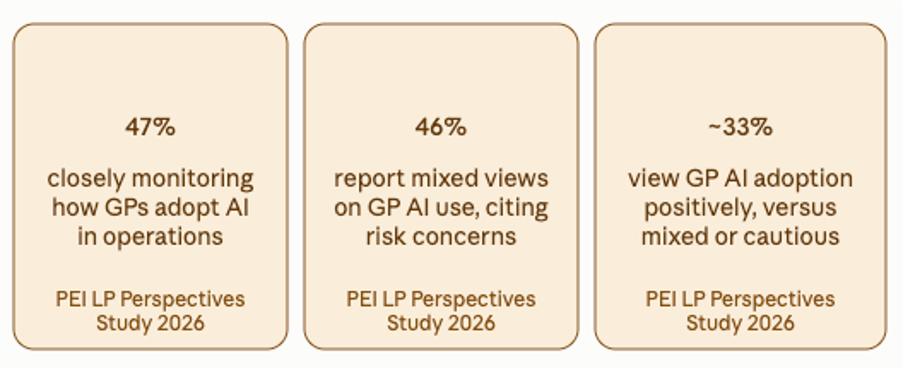
As GPs lean on AI to accelerate reporting production, LPs are watching closely rather than assuming it’s a neutral upgrade. Private Equity International’s LP Perspectives 2026 survey found 47% of LPs are closely monitoring how GPs adopt AI in investment and operational processes, and sentiment is split – only about a third view it clearly positively, while 46% report mixed views driven by risk concerns.
The implication for portals: AI-assisted reporting is welcomed for speed and consistency, but LPs want visibility into how figures were produced and confidence that automation hasn’t compromised accuracy or auditability. A portal that uses AI without a clear, explainable trail from source data to reported figure will invite more scrutiny, not less.
6. Conviction in the asset class is high – so the bar keeps rising
RAISE was built around the idea that these four functions shouldn’t require four different systems – because they never actually stopped None of this is happening against a backdrop of retreating LP interest. Adams Street’s 2026 Global Investor Survey found 84% of LPs still expect private markets to outperform public markets over the long term, and other 2026 surveys show a majority of LPs planning to increase alternatives allocations and expand the number of GP relationships they hold. LPs aren’t pulling back – they’re deploying more capital across more managers, which means they’re relying on portals even more heavily to keep that expanding book comparable and manageable.
More GPs in the portfolio means less tolerance for any one of them being hard to track.
How RAISE helps close the gap
Every one of these expectations points to the same underlying requirement: reporting has to come from a connected system, not a stitched-together set of exports. This is where a unified platform like RAISE has an advantage over point solutions.
- One data source, no re-keying. RAISE brings fund administration, portfolio monitoring, compliance, and the investor portal together on a single platform. Because reporting draws from the same underlying fund data rather than a separate export process, LPs see figures that are consistent with the fund’s books – reducing the reconciliation gaps that erode trust when numbers don’t match across documents.
- See exactly what your LPs see. RAISE lets GPs mirror the LP view of the portal before anything goes live – checking dashboards, reports, and disclosures exactly as an investor would experience them. That means IR teams can catch formatting issues, confirm sensitive data is scoped correctly, and validate the numbers investors will actually read – closing the loop on the “was it accurate, clear, and complete” question before it ever reaches an LP’s inbox.
- One ecosystem, one profile. Because RAISE Connect sits inside the broader RAISE ecosystem, investors don’t have to recreate their profile for every fund or every GP relationship on the platform. A single investor profile carries across funds, so LPs skip the repeated onboarding, KYC, and document uploads that come with each new commitment.
- Fundraising opportunities in the same place LPs already work. That same connected profile gives LPs visibility into new fundraising opportunities across the RAISE ecosystem – not just the fund they’re currently invested in. As GPs raise new vehicles, LPs can discover and evaluate them from the same portal they already use to track performance, rather than starting a new relationship from scratch.
- Real-time insight, not static PDFs. Through RAISE Connect, LPs get live dashboards and real-time visibility into fund performance rather than waiting on the next quarterly mailing. That directly answers the “analytics over documents” preference showing up in LP surveys – investors can check where things stand instead of emailing the IR team to ask.
- Customizable, tailored reporting. RAISE Connect lets GPs configure dashboards and data visualizations per LP, with custom alerts and priority levels – useful for meeting different institutional LPs’ varying reporting formats and cadences without building one-off reports by hand each quarter.
- Secure, auditable document sharing. Confidential documents, capital account statements, and fund communications are shared through the portal with defined access controls, giving LPs (and their own back-office and audit teams) a clear, permissioned trail – the kind of auditability LPs are increasingly asking for as automation plays a bigger role in report production.
- Access anywhere. With the RAISE Connect mobile app, LPs and GPs can review performance, notifications, and fund tasks from any device – meeting the expectation that a portal is a working tool, not just a document mailbox.
For GPs feeling the operational strain of rising reporting standards and growing LP scrutiny, the practical fix isn’t a better PDF template – it’s a platform where the reporting layer is directly connected to the data it’s reporting on.
The takeaway for portal design in 2026
Put together, the survey data points to a portal built around four capabilities:
- Standardized, comparable reporting – capital account statements, fee schedules, and performance data produced in a consistent format LPs can compare across their whole portfolio.
- Granular, auditable fee and expense data – not just a total, but the breakdown LPs are increasingly expected to see.
- Self-service analytics – filtering, comparison, and export tools that let LPs work with their data instead of re-transcribing it.
- Transparent use of automation – if AI is speeding up report production, LPs want a visible line from source data to output.
The portal isn’t just a delivery pipe anymore. For a growing share of LPs, it’s part of the due diligence file itself.
Explore Other Blogs
- What LPs Actually Want From an Investor Portal in 2026
- Fund Admin, Investor Relations, Compliance, Reporting: Why They Shouldn’t Live in Separate Tools
- Where Fund Operations Break at Scale and How COOs Fix It
- How CCOs Modernize Compliance to Reduce Fund Risk
- Designing Investor Journeys Around Real-Time Data Access